The Book of Blocks: The First Block
· Dennis W. Davis


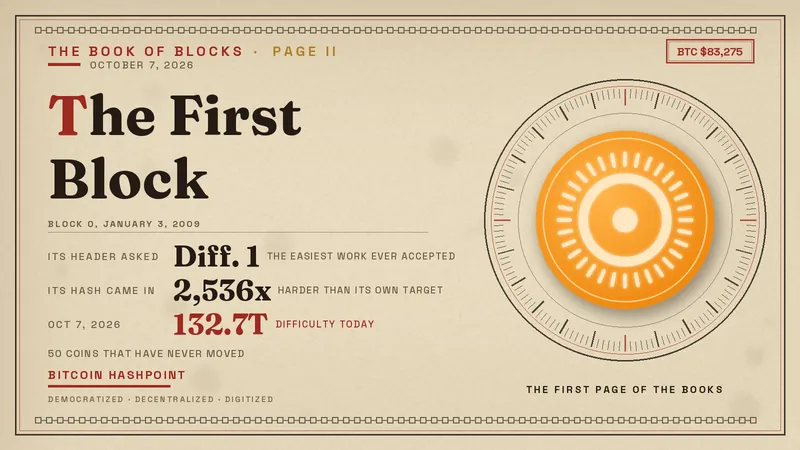
At 18:15:05 UTC on Saturday, January 3, 2009, a computer somewhere produced the first page of Bitcoin's books. Its header asked for the easiest work the protocol would ever accept, difficulty 1. Its hash came back about 2,500 times harder than that.
Block 0, the genesis block, carries a newspaper headline, a number nobody can explain, fifty coins nobody can spend, and a six-day silence before the next block arrived. The community has a story for every one of those facts. This essay sets each story beside the record.
What the block says
Start with the block itself, because every field in it is public and anyone can read it.
The header records a time of 18:15:05 UTC on January 3, 2009, and a target field of 0x1d00ffff, which is difficulty 1. The nonce, the number the miner changed until the hash came out low enough, is 2083236893. The block's hash is 000000000019d6689c085ae165831e934ff763ae46a2a6c172b3f1b60a8ce26f.

The block holds one transaction, the coinbase, which paid fifty new coins to the address 1A1zP1eP5QGefi2DMPTfTL5SLmv7DivfNa. Inside that transaction, Satoshi Nakamoto placed a line of text: "The Times 03/Jan/2009 Chancellor on brink of second bailout for banks." It was the front-page headline of The Times of London that morning, about Alistair Darling and the second rescue of Britain's banks.
The headline does two jobs, and only one of them is political. It proves no one could have made the block before that newspaper existed, the same trick Haber and Stornetta used when they printed fingerprints of their records in The New York Times. It also tells the reader what the author thought about the system the paper set out to route around. The nine pages of October 31 never mentioned the crisis. The first block named it.
Harder than it needed to be
At difficulty 1, a block counts when its hash starts with 32 zero bits, eight zeros in the hexadecimal form people read. The genesis hash starts with 43 zero bits. In plain numbers, the hash came in about 2,536 times below the target its own header set.
Under honest mining at difficulty 1, any single winning hash lands that low about once in 2,500 blocks. That is unusual. It is not impossible.

The legend has it that Satoshi mined the first block on purpose against a far harder target than the rules required, a private test of the machine before the public saw it. Some read the extra zeros as a signature. Others read them as a sign that Satoshi ran the miner many times and kept the best result, the way a craftsman keeps the best casting from a mold. Community analysts also point to a small counter in the coinbase, set to 4, and read it as a sign that the miner ran through its full range of nonces more than once before it found this one.
The record cannot settle it, and that is the honest answer. The header says difficulty 1. The software Satoshi released on January 8, 2009 wrote the genesis block into the code as a fixed object, so no one can watch how Satoshi mined it. A one-in-2,500 result could be luck. It could be a stricter private target. Satoshi never said, and the block keeps its own counsel.
What the record does show is the scale of what followed. As of October 7, 2026, the network's difficulty stood at about 132.7 trillion. Today's blocks need roughly 79 zero bits. The genesis block, which beat its own target 2,500 times over, would have to be about 52 billion times harder to count as a block today.
The six days
Block 1 carries a timestamp of 02:54:25 UTC on January 9, 2009. The network targets one block every ten minutes. The first gap ran close to six days.

The community has filled that gap with stories. Some joke that Satoshi made the world in six days and rested on the seventh. Others hold that Satoshi prepared the genesis block ahead of time and set its timestamp to match the headline, which would make the date a choice rather than a moment. The Bitcoin Wiki records a third idea, the prenet hypothesis: Satoshi ran a private test network until January 9 and then reused the genesis block for the real one.
The record narrows the question. Satoshi announced Bitcoin version 0.1 on the Cryptography Mailing List at 19:27 UTC on January 8. Block 1 arrived about seven and a half hours later. The next ten blocks followed by 04:12 UTC, close to the ten-minute pace the design intended. One explanation, offered by developers who have read the early code, is that the first release would not mine until it found another node to talk to. On that reading, the network did not sleep for six days. It waited for a second computer, and once one joined, it started at once.
The headline sets a floor and no ceiling. It proves no one made the genesis block before January 3. Nothing in the chain proves anyone made it that day.
The coins nobody can spend
The fifty coins in the genesis block have never moved, and they never will. The original code built the genesis block into the program and never added its coinbase to the list of coins the network can spend. Every later block's reward entered that list. This one did not.
The legend has it that Satoshi meant the coins as a gift to the world, or a sacrifice, the first fruits left on the altar. Some read it as a sign that the author wanted no profit from the first page. The Bitcoin Wiki states the plainer truth: nobody knows whether Satoshi did it on purpose.
The address took on a life anyway. Strangers send it coins as tribute, mostly in tiny amounts. One gift in January 2024 ran to about 26 coins, from a sender nobody has identified. The coins sit beside the original fifty in an address no one has ever spent from. It is the closest thing Bitcoin has to a shrine: a place where people leave something valuable to honor a founder who cannot collect it.
The first block at nearly eighteen
| The genesis block | The network on October 7, 2026 |
|---|---|
| Difficulty 1 | Difficulty about 132.7 trillion |
| A hash with 43 zero bits | Blocks need about 79 zero bits |
| Reward of 50 coins | Reward of 3.125 coins |
| One computer, then two | Hashrate near 946 EH/s on the dashboard's latest reading |
| A newspaper headline as proof of date | Block 970,240, each one chained to the block before it, back to this one |
Every block since January 3, 2009 points back to the genesis block through an unbroken chain of hashes. Change one character in the first page and every page after it stops matching. The newspaper proved the first block's age once. The chain has proved it about 970,000 times since.

Verdict
Could anyone ever learn if Satoshi mined the first block harder on purpose?
The evidence says probably not from the chain alone. The block shows a result, not a method. A hash 2,500 times below its target is a one-in-2,500 event under the published rules, and the only witness to its making is the person who made it. That person stopped writing in 2011, and a later essay in this series takes up the last thing he asked. If Satoshi's early notes or a pre-release copy of the code ever surface, they could answer it. Until then the legend and the luck explanation stand side by side, and neither one can be proved.
What the record settles is more important. The first block could not have come before the morning of January 3, 2009. No one has ever rewritten it. Its fifty coins have never moved. Eighteen years from now the genesis block will read exactly as it reads today, and that is the one thing about it nobody has to take on faith.
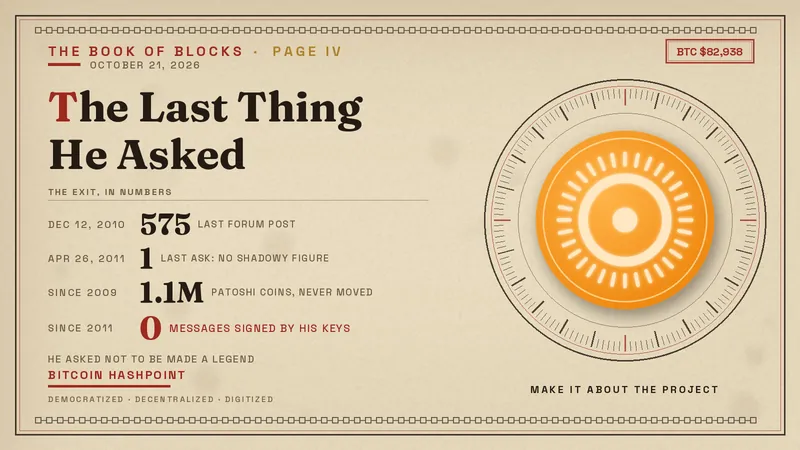
Genesis Day comes on January 3. The series marks it with a story of its own, set off and labeled as the fiction it is.
Data: Bitcoin Wiki, "Genesis block" (timestamp 1231006505, 18:15:05 UTC, January 3, 2009; nonce 2083236893; hash; target field 0x1d00ffff; the coinbase headline; the unspendable reward; the six-day gap and the prenet hypothesis); The Times (London), front page, January 3, 2009; Blockchain.com block explorer (block 1, January 9, 2009, 02:54:25 UTC); Bitcoin Stack Exchange, "Why is there a gap between the Genesis block and Block 1?" (version 0.1 announced January 8, 2009, 19:27 UTC; the next ten blocks by 04:12 UTC; the first release waiting for a peer); Manifold Markets, genesis address tribute history (the January 2024 gift of about 26 coins; mempool.space figures as of block 969,763); Haber and Stornetta, "How to Time-Stamp a Digital Document" (Journal of Cryptology, 1991); Bitcoin Hashpoint calculation from the genesis hash and the difficulty 1 target (43 zero bits; 2,536 times below target; about 52 billion times short of the October 7, 2026 difficulty); Bitcoin Hashpoint dashboard (difficulty, hashrate and block height as of October 7, 2026). Structural reads, not forecasts. Nothing here is investment advice.
Get the Hashpoint by email twice a week, Wednesday and Saturday: subscribe free, one click to unsubscribe.