The Book of Blocks: The First Price
· Dennis W. Davis


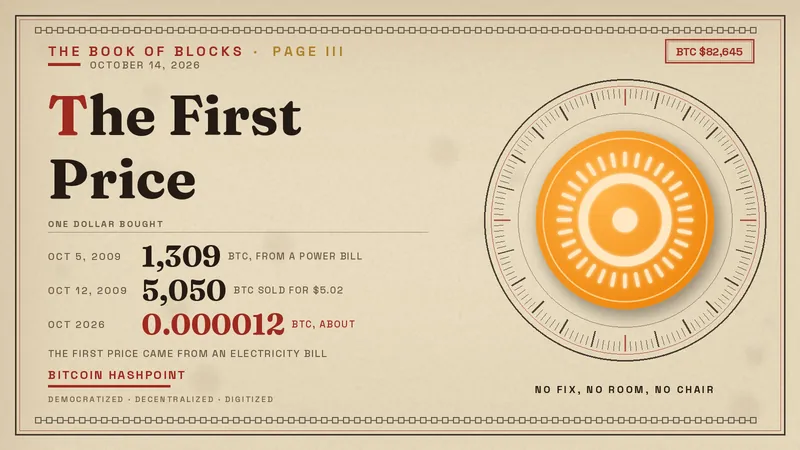
On October 5, 2009, a website called New Liberty Standard posted a number no one had published before: one U.S. dollar would buy 1,309.03 bitcoin. Seven days later, on October 12, a Finnish developer named Martti Malmi sold 5,050 bitcoin to that website for $5.02.
That is the first published price of Bitcoin and the first known sale of it for government money, and both happened seventeen years ago this week. Nobody bid against anybody. No exchange matched an order. The first price came from an electricity bill, and the first seller took a few dollars for coins now worth about $419 million.
The community tells this story as a joke about missed fortunes. The record tells a stranger one, and it makes a good companion to this month's Long Game on London. The oldest benchmark price for the world's oldest money is still set in a city. Bitcoin's first price was set by one person with a calculator.
The power bill
New Liberty Standard was run by a forum member who posted as NewLibertyStandard, and who is known to the record mostly by that name. He wanted Bitcoin to have a price before it had a market, so he built one out of the only cost a miner could measure.
The formula, as he described it, ran like this. Take the electricity a computer with a busy processor uses in a year, 1,331.5 kilowatt-hours. Multiply by the average American residential power rate of the prior year, 11.36 cents. Divide by twelve for a month of running. Then divide by the number of bitcoin that computer had mined over the past thirty days. The answer was what one bitcoin cost to make, and he offered to trade at that rate.
The posted rate lets anyone run the formula backward. A month of power came to about $12.60. For a dollar to buy 1,309.03 coins, the computer had to have mined almost exactly 16,500 coins in the thirty days before, which is 330 blocks at fifty coins each. In October 2009 a single desktop could do that, because almost nobody else was mining.
So the first price of Bitcoin was not a guess about what it might become. It was a receipt for what it had cost: $0.00076 a coin, a little under eight hundredths of a cent.
The first trade
Martti Malmi was not a speculator. He had written to Satoshi Nakamoto in the spring of 2009 and became one of the project's first volunteers, helping build its website and the forum that became the gathering place for its early users. He mined, and by October he had coins to spare.
He sold 5,050 of them to New Liberty Standard for $5.02, paid through PayPal. Years later he gave the date himself: "I sold 5,050 BTC for $5,02 on 2009-10-12." The sale helped seed the exchange.
The arithmetic holds one surprise. Malmi's price works out to about $0.00099 a coin, roughly 30 percent above the rate New Liberty Standard had posted a week earlier. The first trade in Bitcoin's history cleared at a premium to its first quoted price. By the custom of every market since, that counts as Bitcoin's first rally.
At the October 11 price of $82,957, the 5,050 coins would be worth about $419 million. Those who have interviewed him describe a man who never set out to make money from Bitcoin, and he stayed with the project as a developer long after the sale.
The first fall
The first rally did not last. New Liberty Standard updated its rate as the formula's inputs changed, and by December 17, 2009, a dollar bought 1,630.33 coins. Measured in dollars, the price of a bitcoin had fallen about 20 percent in ten weeks. Bitcoin's first quoted price was followed, within the same quarter, by Bitcoin's first drawdown.
Then the market arrived. In March 2010 a forum member called dwdollar opened Bitcoin Market, the first site where buyers and sellers set the price against each other. Its first recorded bid came in at $0.0067 a coin, almost nine times New Liberty Standard's opening rate. By June 2010 New Liberty Standard itself was quoting 221.65 coins to the dollar, about $0.0045. In February 2011, on Mt. Gox, one bitcoin reached one dollar.

| Date | Event | Price of one bitcoin |
|---|---|---|
| October 5, 2009 | New Liberty Standard's first rate, 1,309.03 per dollar | $0.00076 |
| October 12, 2009 | Malmi sells 5,050 coins for $5.02 | $0.00099 |
| December 17, 2009 | Best rate of 2009, 1,630.33 per dollar | $0.00061 |
| March 2010 | First recorded bid on Bitcoin Market | $0.0067 |
| June 6, 2010 | New Liberty Standard, 221.65 per dollar | $0.0045 |
| February 2011 | Parity on Mt. Gox | $1 |
| October 11, 2026 | Seventeen years on | $82,957 |
From the first posted rate to October 11, 2026, the dollar price of a bitcoin has multiplied about 108 million times.
Two ways to make a price
Ninety years before New Liberty Standard, on September 12, 1919, five London bullion firms set the price of gold together for the first time. They were N M Rothschild and Sons, which took the chair, Mocatta and Goldsmid, Pixley and Abell, Samuel Montagu and Company, and Sharps Wilkins. The first London gold price came out at £4 18s 9d an ounce. The bids first went by telephone. Later the firms gathered in person at Rothschild's offices at New Court, and the fix became a ritual that lasted into the twenty-first century. Since 2015 an electronic auction administered by ICE Benchmark Administration has set the LBMA Gold Price twice each London business day, and much of the world's gold is still priced against it.
That is one way to make a price: a few trusted firms, one city, a benchmark the world agrees to use. Bitcoin's first price was the opposite in every respect. One person, no license, a public formula and a PayPal account. Anyone could check his math, and anyone could ignore him and quote a different number. Within six months someone did, and the market took the job away from the formula.
Bitcoin still has no fix. It trades around the clock on hundreds of venues in dozens of countries, and no room anywhere, in London or out of it, sets the price for the rest. The first price was the last time one party could say what a bitcoin was worth and have no one to argue with.
The legend of the floor
The legend that grew from the power bill outlived the bill. It holds that the cost of mining sets a floor under the price, that a bitcoin can never stay for long below what it costs to make. Analysts have built cost-of-production models on that idea for a decade, and miners' costs come up whenever the price falls hard.
The record supports a weaker version. The protocol adjusts difficulty about every two weeks so that blocks keep coming every ten minutes or so. When the price rises, more miners join, difficulty rises, and the cost of a coin rises with it. When the price falls, the least efficient miners shut off, difficulty falls, and the cost follows the price down. On that reading, cost chases price more than it holds it up. New Liberty Standard's own record shows it in miniature: the rate it calculated from cost fell 20 percent in ten weeks because the inputs moved, not because anyone thought Bitcoin was worth less.
The floor this publication tracks is a different idea. The dashboard's power-law floor is a line fitted to Bitcoin's whole price history against time, not a cost, and it read $65,339 on October 11. It describes where the price has held, not why.
Verdict
Was the first price right?
The evidence says it was right about the thing it measured and silent about everything else. It measured what a coin cost to make on one desktop in the autumn of 2009, and the first trade paid 30 percent more than that. Within six months, buyers on a real market were paying nearly nine times the formula, and within sixteen months the price stood more than a thousand times higher. Cost told the first buyer where to start. It never told the market where to stop.
What the record settles is the part that matters. Bitcoin's first price did not come from a vault, a fix or a firm with a seat at the table. It came from a stranger who published his reasoning where anyone could check it, and from a developer willing to take five dollars to give the experiment a market. Seventeen years later the price still comes from people like them, millions at a time, with no one in the chair.
Data: Ronan Manly, "Dawn of Bitcoin Price Discovery 2009-2011," BullionStar (New Liberty Standard's October 5, 2009 rate of 1,309.03 BTC per dollar and its formula; the rates of December 17, 2009 and June 6, 2010; Malmi's sale of 5,050 BTC for $5.02 and his dated statement; Bitcoin Market's March 2010 launch and first bids; Mt. Gox parity in February 2011); Cointelegraph Magazine, "5,050 Bitcoin for $5 in 2009" (PayPal payment, the exchange seeded, Malmi's view of money); CriptoNoticias (the October 5, 2009 anniversary; the operator's forum profile); Perth Mint, "The centenary of the first London gold price" (September 12, 1919, the five founding firms, £4 18s 9d, New Court, ICE Benchmark Administration from 2015); Bitcoin Hashpoint calculation (the implied 16,500 coins in thirty days; Malmi's price 30 percent above the posted rate; the 20 percent decline to December 17; the 108-million multiple); Bitcoin Hashpoint dashboard (Bitcoin $82,956.73 and the power-law floor of $65,339 on October 11, 2026). Structural reads, not forecasts. Nothing here is investment advice.
Get the Hashpoint by email twice a week, Wednesday and Saturday: subscribe free, one click to unsubscribe.