Midweek Dispatch
· Dennis W. Davis
Eight days of bleeding — and nobody's turning off the tap.
Wednesday, May 27, 2026 - Atlanta, GA
Bitcoin has shed more than $3,000 in a week. The ETF era was supposed to smooth these moves. Instead, institutional rails are transmitting macro stress faster than the old wallet-to-wallet world ever could.
A seven-session skid that redrew the map
Bitcoin opened Wednesday at $75,829, slid further through the morning, and by midday futures were printing $74,685 — down more than 1.5% on the session. The move continues a pattern that began on May 14: eight consecutive days of net outflows from U.S. spot Bitcoin ETFs, totaling more than $2 billion in aggregate. The sharpest single-day bite came May 18, when BlackRock's IBIT alone shed $448 million in redemptions.
The proximate cause is a familiar cocktail. U.S. PCE inflation came in hot at 3.8%, the Fed's new chair Kevin Warsh was sworn in with hawkish credentials, and the 10-year Treasury yield has traded near 4.57% before settling back to 4.50% — its highest sustained level in a year. When the risk-free rate pays that, the marginal dollar rotates out of digital assets and into sovereign paper. IBIT has become the exit door.
There is a geopolitical layer too. U.S. strikes in southern Iran rattled risk sentiment Tuesday morning. Investors are watching the Strait of Hormuz; oil prices remain elevated even as both sides signal tentative interest in a resolution. Bitcoin fell in tandem with that news cycle — further evidence of its ongoing "risk asset" classification in institutional portfolios, even as Bitcoin advocates insist on its safe-haven credentials.
Tech breaks records. Bitcoin breaks support.
The strangest feature of this week's tape is the growing gap between Bitcoin and the tech stocks it often tracks. Semiconductor names have surged to historic highs — SK Hynix briefly joined Micron in the trillion-dollar club — while BTC has shed roughly $3,000 from its weekly open of $77,230. Consumer confidence is slumping. PCE is hot. And yet the Nasdaq is climbing. The divergence invites one of two readings: either tech is ahead of itself, or Bitcoin is pricing something the equity market is not yet acknowledging.
- —Jane Street reportedly reduced its spot Bitcoin ETF holdings by roughly 70% in Q1 2026. Goldman Sachs also trimmed.
- —BlackRock's tokenized fund business crossed $2.5 billion in assets — expanding digital rails even as ETF flows retreat.
- —Block began a phased stablecoin rollout across its 60 million Cash App users.
- —ARMA legislation proposes forcing the federal government to hold $25 billion in Bitcoin for two decades.
- —Reports surfaced of a potential SpaceX-Tesla merger — which would create the world's fifth-largest corporate Bitcoin treasury at ~$3.3 billion.
- —Markets now price 54–70% odds of zero Fed rate cuts in 2026, with rate hike bets climbing.
The pressure valve is doing its job — for now
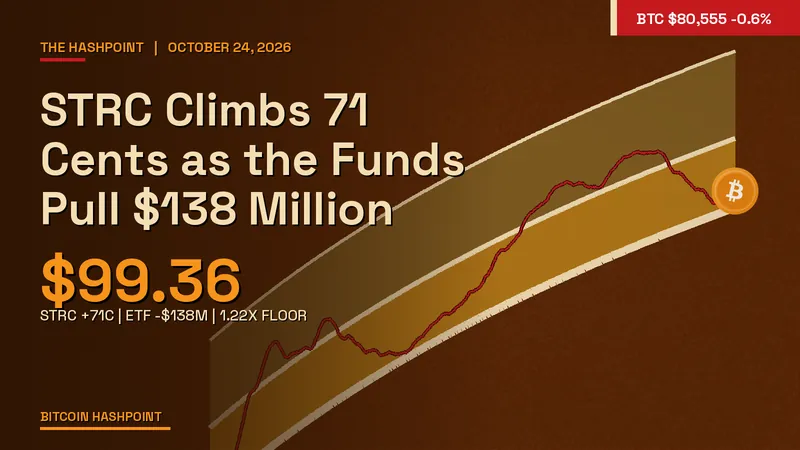
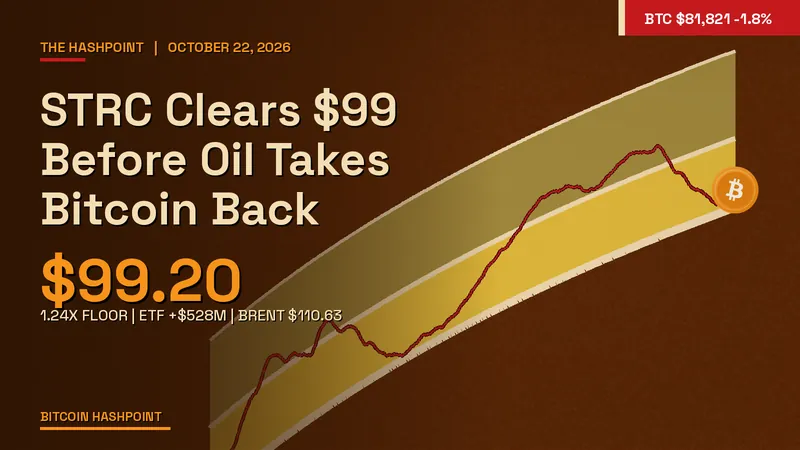
Strategy's Variable Rate Preferred Stock (STRC) is trading at $99.47 with an 11.58% annualized yield. That is below the $100 par level the instrument's escalator is designed to defend. Under the framework Strategy filed with the SEC in February, a VWAP below $95.00 triggers a dividend rate increase of 50 basis points or more for the following month; the $95–$98.99 band triggers a 25bp increase. At $99.47, the instrument sits in the "no change anticipated" zone — just barely.
The deeper question is whether rising yields can suppress STRC's market price into the escalation zone (below $95) persistently enough to throttle Strategy's accumulation rate. So far, the answer is no — but the instrument has only faced one serious rate-shock cycle since its launch. The monthly repricing lag is a structural feature that becomes a vulnerability precisely when yields move fastest.
Eight straight days of outflows is not noise. It is a regime signal. The question is whether this is a rotation within a bull market — institutions shedding ETF exposure ahead of a summer vol event before reloading — or the beginning of a more durable de-risking. Polymarket is pricing a 65–71% probability that Bitcoin falls below $55,000 before year-end. That is a meaningful shift from prior weeks. Strategy's Bitcoin accumulation, meanwhile, is still expected to continue; prediction markets give it 96% odds of holding above 800,000 BTC by December.
Those two forecasts can coexist. Corporate buyers are not price-sensitive in the way ETF holders are. But if spot ETF demand — the institutional float — is impaired for the rest of 2026, Strategy accumulates into a thinner bid. The math gets lonelier at the margin.
Midweek dispatches appear occasionally, not on a fixed schedule. Prices sourced intraday May 27, 2026. ETF flow data via Farside Investors. STRC framework per Strategy 8-K filed February 2026. Nothing here is financial advice.
Get the Hashpoint by email twice a week, Wednesday and Saturday: subscribe free, one click to unsubscribe.