Inside the STRC Par Defense: Why $99.30 Matters More Than $77,000
· Dennis W. Davis
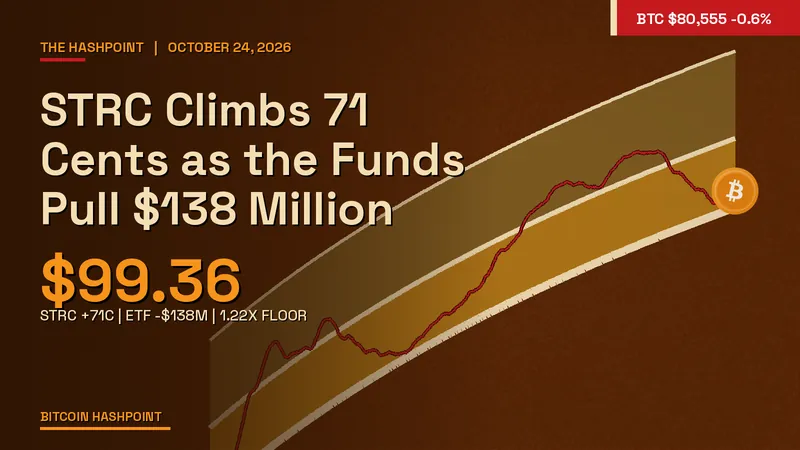
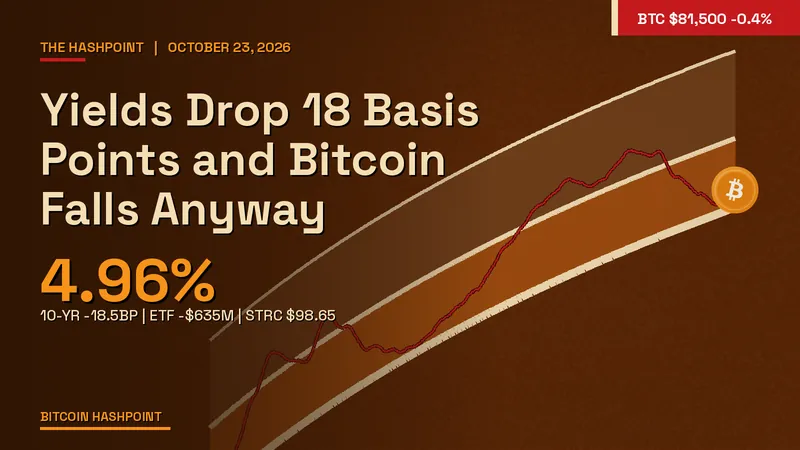
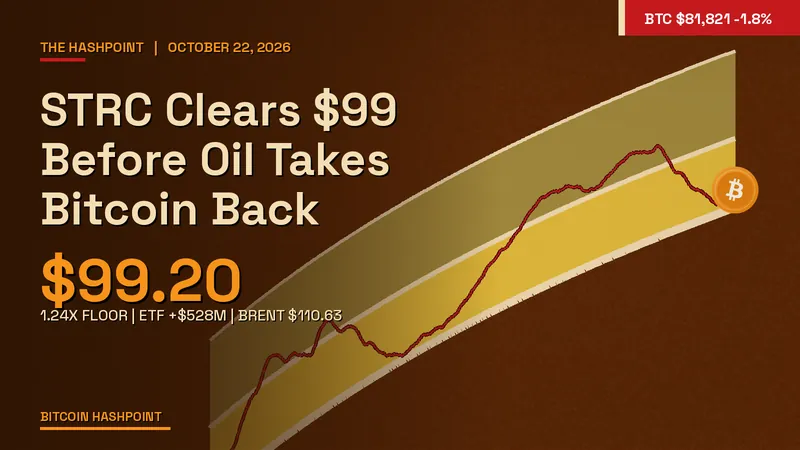
When most observers look at Bitcoin's price chart, they look at the BTC number. When we look at the dashboard, the most important number this week has been a different one: STRC at $99.30.
Strategy's perpetual preferred stock, ticker STRC on Nasdaq, has a stated par value of $100 and pays an annual dividend currently set at 11.50%, distributed monthly. The dividend rate is adjustable by the issuer on a monthly cadence, calibrated to encourage STRC to trade near its par value. The mechanism is the closest thing in public markets to an explicit anchor on a security's price.
The reason this matters for Bitcoin is mechanical, not narrative. Strategy raises capital through STRC's at-the-market issuance program, selling new STRC shares directly into the market when conditions are favorable. When STRC trades at or above par, the issuance is accretive. When STRC trades below par, issuance at a discount damages the funding apparatus. The company exercises self-imposed discipline by halting issuance when STRC slips below par.
Year-to-date through early May, Strategy has raised approximately $5.58 billion through STRC alone. That capital has been deployed almost entirely into Bitcoin purchases. The mechanism has functioned as the most reliable institutional bid in the Bitcoin market in 2026, scaled larger than the net inflows into all U.S. spot Bitcoin ETFs combined.
This week, with STRC trading 70 basis points below par and the at-the-market program halted, that bid is suspended.
There is a secondary mechanical consequence to watch. STRC's terms include a dividend escalator clause. If STRC trades at or below $99.49 on a volume-weighted basis from May 1 through May 28, Strategy is required to raise the dividend rate by 25 basis points to 11.75% on all outstanding STRC shares. Given approximately $10.5 billion in outstanding STRC, the incremental cost is meaningful: roughly $26 million annually on a sustained basis.
The company's annual financing cost on the full Bitcoin position is now approximately $1.7 billion, or 2.7% of total Bitcoin holdings. A dividend escalation raises that further. The mechanism continues to function, but at lower efficiency.
For readers tracking the structural state of Bitcoin in 2026, the STRC price tells you two things the BTC price cannot. First, it tells you whether Strategy's bid is active or suspended. Second, it tells you the marginal cost of the largest sustained institutional accumulation channel. As long as STRC sits below par, the analytical conclusion is unambiguous: the bid is suspended, and the cost to restart it is rising.
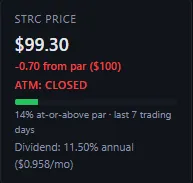
What we monitor for the week of May 25 is whether STRC recovers above $100 on a sustained basis. The dashboard's STRC card displays at-or-above-par percentage for the trailing seven trading days. As of this writing, that reading is 14%. The threshold to watch is the return to 100%: sustained par defense, ATM reopened, accumulation resumed.
Until then, the most important number in the Bitcoin market is one that most observers are not watching.
Get the Hashpoint by email twice a week, Wednesday and Saturday: subscribe free, one click to unsubscribe.