The 2007 Number
· Dennis W. Davis
The 30-year Treasury yield hit 5.197% on May 20. Its highest since July 2007. What that number means for Bitcoin, and why bond market volatility is the variable that matters most right now.
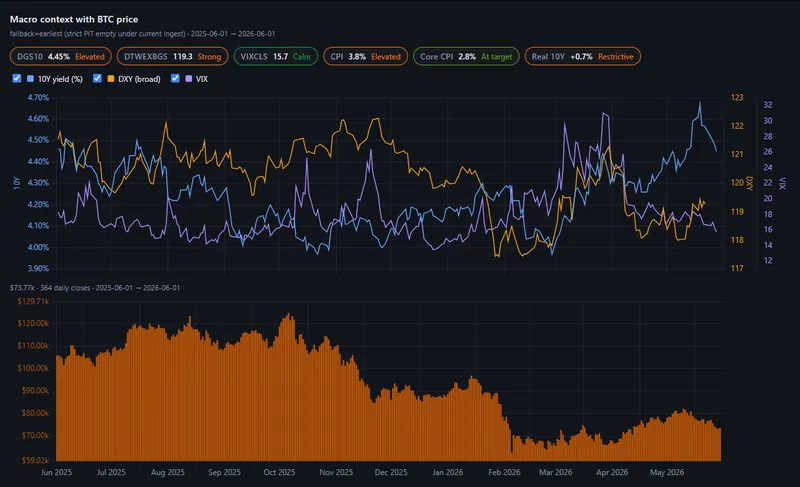
The equity market is calm. The VIX sits at 15.32. By that measure, this is not a stress environment.
The bond market tells a different story.
On May 20, the 30-year U.S. Treasury yield hit 5.197%. That is the highest print since July 2007. Before the financial crisis, before quantitative easing, before a decade and a half of suppressed rates. The 10-year yield has held near 4.44%, still elevated by historical standards and still carrying the "Restrictive" label on the Hashpoint dashboard's macro panel.
The mechanism through which long-dated Treasury yields affect Bitcoin is not intuitive to everyone, so it is worth stating plainly again. Bitcoin produces no yield. Its value is a function of what investors believe it will be worth in the future relative to what they give up today. When the 30-year Treasury yields 5.197%, the opportunity cost of holding a non-yielding asset is not theoretical. It is 5.197% annually, guaranteed, with the full faith and credit of the U.S. government behind it. Capital that allocates to Bitcoin instead of long Treasuries is making a bet that Bitcoin's appreciation will exceed 5.197% annualized. And, is taking on substantially more volatility to do it.
That is not an impossible bet. The Hashpoint model's 1-year target is $197,199, which from $73,771 implies a 167% return. The power law does not require a favorable short-term rate environment. But in the near term, elevated long yields raise the hurdle rate for incremental allocation. And when yields spike, as they did on May 20, the liquidation of leveraged long positions follows mechanically. The $100 million in liquidations that accompanied the May 20 yield spike were not sentiment. They were math.
Kevin Warsh, sworn in as Federal Reserve Chair on May 22, faces an environment that could not be more complicated. Inflation has been running above the Fed's 2% target for five consecutive years. The April CPI print came in at 3.8%. The 30-year yield hitting levels not seen since 2007 is a bond market message: the era of cheap money is not returning quickly, and the market does not believe the Fed can deliver rate cuts without reigniting inflation.
Warsh's first policy meeting is in June. His stated commitment is to Fed independence and price stability. Trump's stated preference is rate cuts. The tension between those two positions will define the macro environment for Bitcoin through the summer.
The number to watch in the week of June 1 is not the VIX. It is the 10-year yield. A sustained move toward 4.25% would begin to relieve the ceiling on risk assets including Bitcoin. A move toward 4.7% or above would press the $73,197 floor and test the compression band from below.
Get the Hashpoint by email twice a week, Wednesday and Saturday: subscribe free, one click to unsubscribe.