The Long Game: Salvation Today
· Dennis W. Davis
The Long Game is the Hashpoint's essay series: the ideas that play out over decades, not days. Bitcoin Hashpoint, October 7, 2026
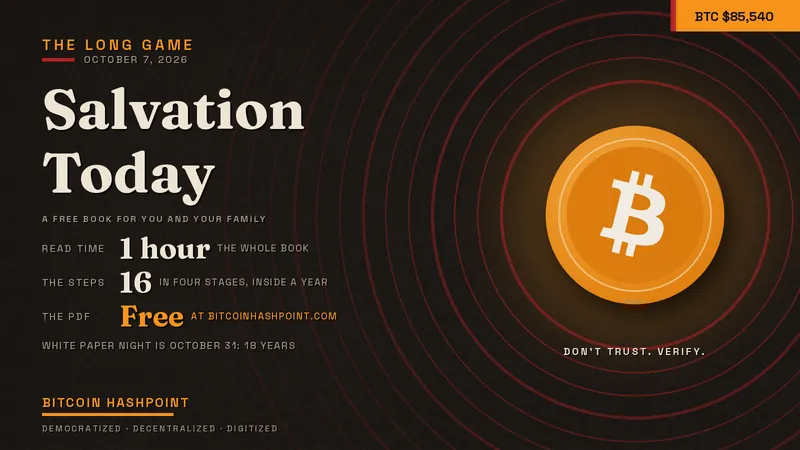
Today the Hashpoint publishes its first book. Salvation Today costs nothing, takes about an hour to read, and speaks to the people who will never open a dashboard: the families who feel the treadmill every month and have never seen the reason laid out in plain words.
The daily edition tracks bands and flows. The book steps back from all of it and asks one question. What should a household do with what the data shows? The answer runs ten chapters, opens with the nine pages Satoshi Nakamoto published on October 31, 2008, and closes with steps a family can finish inside a year.
What the book is
The first chapter walks through the white paper section by section, for anyone who wants a guide on the first pass. The full paper sits in the back, as Satoshi released it, so a reader can check every claim against the source. The book never asks for faith. Its creed is the one the Bitcoin community already lives by: don't trust, verify.
Every number in the book comes from a public record, and a Sources section names each one. More than thirty charts carry the figures, from the attacker's odds in section 11 of the white paper to the household debt mountain. Illustrations carry a label so no one mistakes a drawing for data.
One promise stays off every page: price. The book teaches custody and patience. It never says what a coin will be worth, and nothing in it is investment advice.
The case, in the book's own numbers
The book builds its argument from records anyone can pull.
Since 1933 the dollar has lost about 99.5 percent of its value against gold. A fine garment shows what that means. Rome's finest hooded cloak cost 2.19 ounces of gold in 301 AD. A bespoke Savile Row suit costs about 2.0 ounces today. Across seventeen centuries the finest work of skilled hands held between two and four ounces, while technology made ordinary clothing far cheaper. The dollar hid both facts.
The same shape shows up in the biggest purchase most families make. The median American house sold for $224,100 in the third quarter of 2010 and $410,700 in the second quarter of 2026, up 83 percent. Measured in bitcoin, it fell from 4.53 million coins to 4.87. The house did not change. The ruler did.
Savings tell the rest. The average U.S. savings account paid 0.37 percent in September 2026 while prices rose 3.4 percent over the latest year. Money in the bank lost about 3 percent of its buying power with no line on any statement to show it. Households answered the way the system trains them to: they borrowed. They owed $18.77 trillion at the end of June, and the federal government paid $1.02 trillion in interest in the first eleven months of fiscal 2026.
Against that, Bitcoin's adoption has barely begun. Its realized capitalization stood at $1.08 trillion in late September, about 0.2 percent of the world's $517 trillion in wealth. Gold holds roughly 6 percent.
The book gives the hard numbers equal space. Bitcoin fell more than 75 percent from its peak in 2018 and again in 2022. A loan against coins can force a sale at the bottom. The people who came through every cycle owned their coins outright and kept a cushion in the bank.
Sixteen steps
The eighth chapter turns the argument into a plan. Sixteen steps fall into four stages, and none of them needs a forecast.
The first stage clears the ground. Write down every debt and cost, build three to six months of cash, pay off anything charging more than 20 percent, and never borrow to buy. The second stage hands a family its first keys: read the nine pages, choose a wallet, write the recovery words on paper or metal, and restore from them before trusting the wallet with more. The third stage builds habits, from buying on a schedule to keeping quiet about what you hold. The last stage brings the family in: teach one other person, write a letter of instruction, and open a small wallet for each child.
The sharpest line in the chapter sits in step seven: anyone who asks for your recovery words is a thief, every time.

A calendar to hold the habit
A habit lasts when a calendar holds it, so the ninth chapter gives Bitcoin a year to keep. The Book of Days lists nine fixed feasts, each tied to a date in the record.
The year begins on White Paper Night, October 31. Genesis Day on January 3 marks the first block and its bailout headline, and the community keeps it with Proof of Keys, moving coins off every exchange into keys its members hold. Pizza Day on May 22 remembers the 10,000 coins Laszlo Hanyecz paid for two pizzas in 2010.
The chain sets the moveable feasts. The Millionth Block arrives once in history, expected in the spring of 2027. The Halving Jubilee comes at block 1,050,000, around April 2028. The book also names a new one: the Meridian, the middle of each four-year epoch, 105,000 blocks after a Jubilee. The last Meridian fell at block 945,000 in April 2026. At each one, a holder writes a sealed letter to the next Jubilee about what they hold and why.

White Paper Night
On October 31 the white paper turns eighteen, and Halloween hands every Bitcoiner the one night of the year when the neighbors come to the door.
The Hashpoint built a pamphlet for it. The Best Treat on the Block is a free tri-fold that tells the ghost story with a happy ending: a stranger posted nine pages on Halloween 2008, launched the network ten weeks later and vanished. Inside, it shows the treadmill, the 21 million cap and six steps for a family, and it carries a code that leads to the free book.
The book sets the rules of the pamphlet, and they keep the night friendly. Candy goes to the children and pamphlets to the adults. Teach custody, never price. Ask for nothing, and respect the no. A closed door stays closed.
How to get it
- The book, free. Sign up at bitcoinhashpoint.com/salvation-today/ and tap Confirm in the email that follows. The download opens on the next page.
- The pamphlet, free. Download it at bitcoinhashpoint.com/white-paper-night/, with no signup. One file prints at home on letter paper, both sides, flipped on the short edge. The other carries bleed for a print shop.
- The paperback. A printed edition is on its way to Amazon at close to the cost of printing. The PDF stays free.
What to watch
- October 31, White Paper Night. Eighteen years since the nine pages. The pamphlet's first season.
- November 26, the Feast of Abundance. Thanksgiving kept for what human ingenuity made cheap, with the Abundance Count at the table.
- January 3, 2027, Genesis Day. Proof of Keys. Exchange balances in the days around it show how many holders took the rite to heart.
- Block 1,000,000, spring 2027. A million blocks with no rewrite of history.
- Block 1,050,000, about April 2028. The fifth halving, when new issuance drops to about 0.4 percent a year.
The Hashpoint read
The daily edition measures where Bitcoin stands. The book explains why a family should care and what to do about it, and it does so without a single price target. That restraint is the point. A melting currency rewards the people who spend and borrow, and a money with a fixed supply rewards the people patient enough to save. The book argues for patience with the record in hand and asks the reader to check every line.
Salvation, in the old sense, meant rescue. The book means it plainly: rescue from the rat race and the debt spiral, available this week, on the reader's own terms. Read the nine pages tonight. Hand the next person a pamphlet on the last night of October.
Sources and method
Every figure in this edition comes from Salvation Today, which names its sources in full. The book draws on these records and Hashpoint editions:
- Satoshi Nakamoto, Bitcoin: A Peer-to-Peer Electronic Cash System, October 31, 2008, bitcoin.org/bitcoin.pdf, and the Nakamoto Institute copy at nakamotoinstitute.org/library/bitcoin.
- Bitcoin Hashpoint, "The Ounce and the Suit," October 5, 2026 (Diocletian's edict, Savile Row pricing, gold at $4,218 on October 2, 2026, and the dollar's loss against gold since 1933).
- U.S. Census Bureau and HUD, median sales price of houses sold, FRED series MSPUS; bitcoin prices via the Hashpoint dashboard.
- FDIC national rates, savings average for September 2026; latest annual consumer price reading, as carried in Bitcoin Hashpoint, "The Slow Run."
- Federal Reserve Bank of New York, Household Debt and Credit Report, Q2 2026.
- Peter G. Peterson Foundation, monthly interest tracker, fiscal 2026 through August.
- Bitcoin Hashpoint, "You Are Here" (realized capitalization from Coin Metrics; UBS Global Wealth Report 2026).
- Bitcoin Hashpoint dashboard, block heights and the April 2028 halving estimate.
- Laszlo Hanyecz, pizza for bitcoins thread, Bitcointalk, May 2010.
Structural reads, not forecasts. Nothing here is investment advice.
Get the Hashpoint by email twice a week, Wednesday and Saturday: subscribe free, one click to unsubscribe.