The Long Game: The Longest Game
· Dennis W. Davis
The Long Game is the Hashpoint's essay series: the ideas that play out over decades, not days. Bitcoin Hashpoint, October 19, 2026

This month, on CBS's Face the Nation, Palantir's chief technology officer, Shyam Sankar, told a strange story. "So many researchers have started smoking," he said, "as a way of signaling to other researchers how much they believe in AI." The logic runs like this. You only light a cigarette if you expect the damage not to matter, and the damage only stops mattering if machines fix human biology before the bill comes due.
Sankar told the story as a warning. He called the mood in Silicon Valley a "mass psychosis," and he offered no evidence for the smoking claim.
The bet underneath it still deserves a hearing. The people making it run the largest AI labs on Earth, and this publication lives on long horizons. Bitcoin asks its holders to think in decades. This essay asks what happens to a saver's arithmetic if the decades stop running out.
The bet
In January 2025, at the World Economic Forum in Davos, Anthropic's chief executive, Dario Amodei, called a doubling of the human lifespan "not at all crazy" as a century's work for biology. Then he compressed the century: if AI speeds the science, "we may be able to get that in five to ten years." His essay "Machines of Loving Grace," from the previous October, went further. It described a world where most people alive today could live as long as they choose.
Demis Hassabis of Google DeepMind shared the 2024 Nobel Prize in Chemistry for AlphaFold, the system that predicted the shapes of nearly every known protein. In April 2025 he told 60 Minutes that the end of disease sits within reach: "Maybe within the next decade or so, I don't see why not."
The inventor Ray Kurzweil names the turning point and dates it. He calls it longevity escape velocity, the year medicine starts adding more than one year of life expectancy for every year that passes. From then on, a person gains time faster than the calendar takes it. Kurzweil says 2029.
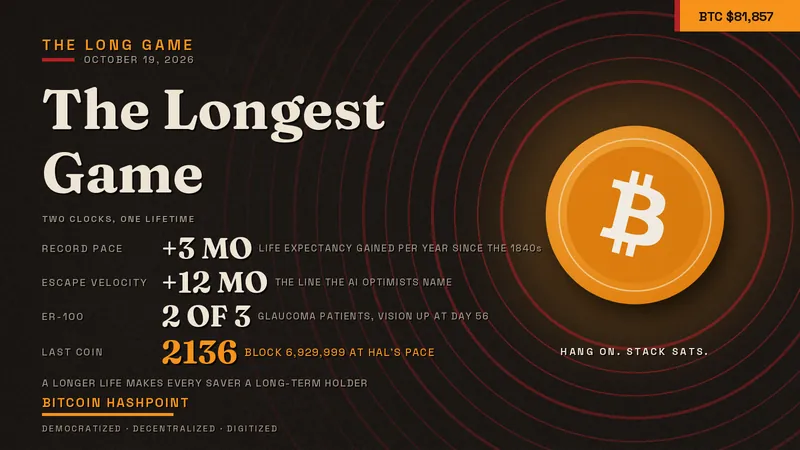
The history shows how big a jump that would take. In 2002 the demographers James Oeppen and James Vaupel showed in Science that record life expectancy, the best figure any country posted, had climbed about three months a year since the 1840s, in a line so straight it looked like a law. Escape velocity means four times that pace, held year after year.

What the labs have actually shown
The science behind the bet starts in 2006. That year Shinya Yamanaka found four genes that turn an adult cell back into an embryonic one, and the discovery earned him a share of the 2012 Nobel Prize in Physiology or Medicine. A full reset erases a cell's identity along with its age, so researchers went looking for a partial one.
In 2020, David Sinclair's lab at Harvard published that partial version in Nature. Using three of the four genes, a set called OSK, the team restored sight in mice with crushed optic nerves and in old mice whose vision had faded. The treated cells switched their genes on and off like younger cells. Sinclair compares the effect to restoring software from a backup copy that every cell may still carry.
This year the idea reached people. Life Biosciences, a company Sinclair co-founded, dosed the first patient in a Phase 1 trial of ER-100, an OSK gene therapy for optic nerve disease, in June. On October 8 it reported the first human data. Three glaucoma patients tolerated the treatment through day 56 with no serious adverse events, and two of the three improved on visual-field tests, with at least 28 percent of the tested points improving in each.
AI has reached the lab bench too. In August 2025, OpenAI and Retro Biosciences reported that GPT-4b micro, a model trained on protein sequences, had redesigned two of Yamanaka's factors. In lab dishes, the new versions drove more than 50 times the expression of stem-cell reprogramming markers that the natural proteins produced.
Nature already runs longer programs on the same vertebrate toolkit. Radiocarbon dating of eye lenses, published in Science in 2016, showed that Greenland sharks live at least 272 years, and the largest shark in that study came out at roughly 392.
The case for patience
The skeptics bring numbers too, and they deserve the same airing.
In October 2024, S. Jay Olshansky of the University of Illinois Chicago and his colleagues published "Implausibility of Radical Life Extension in Humans in the Twenty-First Century" in Nature Aging. Across the longest-lived populations, life expectancy at birth rose about six and a half years over roughly three decades from 1990. That works out to a little over two months a year, slower than the old record trend and nowhere near escape velocity. Olshansky called planning around most people living to 100 "profoundly bad advice."
The new evidence stays thin. ER-100's signal comes from three patients, one treated eye each, no control group and 56 days of follow-up, in a trial built to test safety. GPT-4b micro's 50-fold result comes from cells in a dish, and OpenAI discloses that Sam Altman invested in Retro. Hassabis and Amodei run companies that sell AI. Sankar, who told the smoking story, thinks the whole mood has outrun the facts.
None of that refutes the bet. It prices it. A three-patient signal in glaucoma sits a long way from a whole-body reset, and an honest reader holds both facts at once.
Who pays
The usual objection asks who gets the cure first. History answers with a price curve.
In 2013 Gilead's hepatitis C drug Sovaldi cost about $84,000 a course in America. Egypt, home to one of the world's worst hepatitis C epidemics, began producing the treatment locally in 2015 and brought the cost to about 1,485 Egyptian pounds, roughly 70 euros. By 2017 it had cured about 1.3 million people.
The demand side dwarfs any drug in history. In 2021, Andrew Scott, Martin Ellison and Sinclair estimated in Nature Aging that slowing aging enough to add one year of life expectancy would be worth $38 trillion to the United States alone. Ten years came to $367 trillion. A market that size pulls prices down.
What a long life does to money
Here the essay turns to the Hashpoint's own ground. Whatever biology delivers, a longer life changes the arithmetic of saving, and the change cuts one way.
The Federal Reserve targets 2 percent inflation. At exactly that target, a dollar keeps about 21 percent of its buying power over 80 years and about 5 percent over 150. The record runs worse than the target. Since the Fed opened in 1913, the dollar has lost about 97 percent of its purchasing power: the consumer price index stood at 9.9 that year and reads 336.94 now.

A short life hides that leak. A retiree spends savings down over twenty years, and the erosion takes a modest bite. A 150-year life turns the leak into the main event. A saver who expects to live that long becomes the heir to their own estate, and needs a store of value that no central bank can dilute across a lifetime.
Economists call the trade between now and later time preference. Lower it, and people save more and plan further out. Bitcoin rewards a low time preference by design, with a fixed schedule written into rules that any node can check. A longer life lowers time preference on its own. The two fit.
Hal, the Hashpoint's node, keeps a long count of that schedule. The last coin comes with block 6,929,999. At Hal's measured pace the network reaches it around 2136, and at the protocol's ten-minute target around 2140. When it lands, the supply stops at 20,999,999.9769 bitcoin, a hair under 21 million because the subsidy rounds down to whole satoshis. About 20.1 million exist today.
Now put a child born this year on that timeline. An ordinary eighty-year life ends around 2106, three decades before the last coin. The 150 years Amodei describes would carry the same child to block 6,929,999 at about 110, with decades left over. For the first time, a person alive today could plausibly hold bitcoin from the early years of the count to its final block.
Make it through
The video that brought this question to the Hashpoint, a seventeen-minute case for AI-driven longevity, closes on a plain instruction: make it through the next ten years. Its list holds no secret. Quit smoking, which it says gives back about three years even at 60. Walk after meals. Build strength and balance, since falls lead the causes of injury death for Americans over 65. Wear a seatbelt.
None of it promises forever. It keeps a person in the game long enough to see what the labs produce.
The money side follows the same logic, and nobody needs to believe in a 150-year life to act on it. A saver who plans for a long life and gets an ordinary one gives up little. A saver who plans for an ordinary life and gets a long one spends the second century broke.
The Hashpoint read
Two clocks run through this essay. Anyone can read bitcoin's issuance clock today, block by block, out to 2140. Researchers have only begun to read the epigenetic clock inside every cell, and its first human data covers three patients and 56 days.
The Hashpoint makes no forecast on the second clock. The structural read stands without one: the longer the horizon, the more a saver loses to money that leaks, and the more a fixed schedule is worth. Escape velocity would stretch every horizon at once. Even without it, record life expectancy has climbed for nearly two centuries, so each generation of savers plays a longer game than the one before.
Optimists often arrive early. Sometimes they arrive anyway, the way a $84,000 cure became a 70-euro treatment and a protein puzzle fell to a machine. The publication's own habit fits in one line. Hang on, and stack sats.
Data: Fortune, October 13, 2026, on Shyam Sankar's Face the Nation remarks; Dario Amodei at the World Economic Forum, January 23, 2025, and "Machines of Loving Grace," October 2024; Demis Hassabis on CBS 60 Minutes, April 2025, via Business Today; Ray Kurzweil on longevity escape velocity via Xataka; Oeppen and Vaupel, "Broken Limits to Life Expectancy," Science, 2002, via INED; Yamanaka and Takahashi, Cell, 2006; Lu et al., Nature, 2020; Life Biosciences releases of June 9 and October 8, 2026, on ER-100; OpenAI and Retro Biosciences, August 22, 2025, on GPT-4b micro; Nielsen et al., Science, 2016, on Greenland shark longevity; Olshansky et al., Nature Aging, October 7, 2024, via the University of Illinois Chicago; Africanews, September 2017, on Egypt's hepatitis C program; Scott, Ellison and Sinclair, Nature Aging, 2021, via London Business School; BLS CPI-U via officialdata.org, 1913 = 9.9, 2026 = 336.94; CDC on falls among adults 65 and older; Bitcoin Hashpoint node Hal, chain calendar and supply audit of October 13, 2026. Structural reads, not forecasts. Nothing here is medical or investment advice.
Get the Hashpoint by email twice a week, Wednesday and Saturday: subscribe free, one click to unsubscribe.