The Long Game: The Coiled Spring
· Dennis W. Davis
The Long Game is the Hashpoint's essay series: the ideas that play out over decades, not days. Bitcoin Hashpoint, October 13, 2026

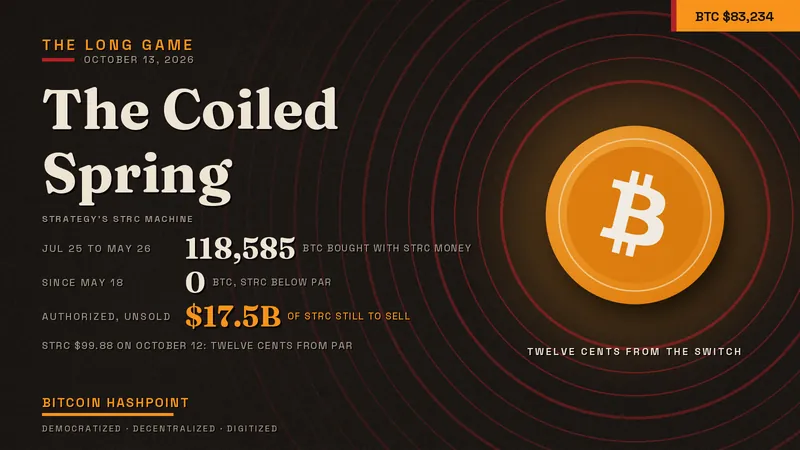
On October 12, Strategy's variable-rate preferred stock, STRC, closed at $99.88. That is twelve cents below the $100 line that decides whether the largest corporate buyer of bitcoin can sell it again, and the closest it has come since it fell under that line in May.
Watch that line long enough and a pattern shows itself. When STRC trades at par, Strategy sells it, and the money buys bitcoin in amounts that dwarf the daily supply. When STRC slips under par, the selling stops, and the buying with it. Since May the machine has been idle. A reader who has followed it for a year could fairly call it a coiled spring.
This edition tests that idea against the record: what the STRC machine bought, what it did to the price, what keeps it coiled and how much energy it is holding.
How the machine works
STRC is a preferred share with a stated value of $100 and a dividend that Strategy resets each month, now 12 percent a year. Strategy sells it into the market a little at a time, through an at-the-market program, and turns the cash into bitcoin.
One rule governs the whole thing. Strategy's own quarterly filing says it intends "not to issue STRC Stock at prices below its $100 stated amount." Selling a $100 promise for $99 would be borrowing at a worse rate than the coupon says, so the company waits. The dashboard tracks this as the issuance state, and it has read closed or marginal since May.
What it bought
The research behind this essay rebuilt every Strategy filing since STRC's first week of sales, the week of July 28, 2025, splitting each week's spending by where the money came from.

| STRC's first 41 weeks (to mid-May 2026) | The 20 weeks since | |
|---|---|---|
| Bitcoin bought with STRC money | 118,585 | 0 |
| All bitcoin Strategy bought | 235,970 | 11,209 |
| Bitcoin Strategy sold | 0 | 6,948 |
| Bitcoin mined | 132,025 | 62,669 |
| Spot ETF net, in bitcoin | 29,627 | -21,608 |
| STRC bought back by Strategy | none | $1.45 billion |
In its first 41 weeks, STRC raised $10.15 billion and bought about 118,585 coins. That was half of everything Strategy bought, equal to 90 percent of every coin mined in the same weeks, and four times what all the spot ETFs added together.
It did not arrive evenly. Only 16 of those 41 weeks had any STRC money in them, and the five biggest weeks carried 88 percent of it. The largest, April 13 to 19, 2026, raised $2.18 billion and bought 29,246 coins, about nine weeks of mining in seven days.
Since May 18 it has bought nothing at all.
The test
If STRC buying pushes the price up, the weeks with heavy STRC buying should show it. They do, a little. In the six weeks with the largest STRC buying, bitcoin's median return that same week was 2.2 percent. In the 45 weeks with none, it was minus 0.2 percent.
The margin is thinner than it looks. With so few weeks, the honest ranges around those two numbers overlap heavily, and the edge disappears one week out and four weeks out. When the same weeks are measured against the spot ETFs' flows as well, the ETFs carry the weight: about 3.3 percent of price movement per billion dollars of ETF flow, against 0.3 percent per billion of STRC money, with an error on the STRC figure four times its size. And no lead or lag between STRC issuance and the price clears the bar of chance. Sixty-one weeks cannot say whether STRC's buying moves bitcoin or bitcoin's strength reopens STRC.
The hand and the tide
The five biggest STRC weeks tell the same story more plainly.

| Week | STRC raised | Bitcoin bought | ETF flow | Bitcoin that week |
|---|---|---|---|---|
| Mar 9 to 15, 2026 | $1.18 billion | 16,726 | +$763 million | +10.4% |
| Apr 6 to 12, 2026 | $1.00 billion | 13,927 | +$833 million | +2.5% |
| Apr 13 to 19, 2026 | $2.18 billion | 29,246 | +$997 million | +4.3% |
| May 11 to 17, 2026 | $1.95 billion | 23,845 | -$996 million | -5.8% |
| Jul 28 to Aug 3, 2025 | $2.46 billion | 21,021 | -$643 million | -4.4% |
In every one of the five, bitcoin moved the way the ETFs moved. When the funds bought alongside STRC, the price rose. When the funds sold, the price fell even in weeks when STRC bought more than seven weeks of mining.
That is the most useful thing the record says. STRC is a very large hand. The tide still decides which way the water runs.
Why the spring limits itself
The machine has a governor built in. Selling a lot of STRC pushes its price down, because buyers have to absorb the new shares. In the peak week of April, STRC ended at $99.21. In the second-biggest week by coins, in May, it ended at $99.19. The heaviest buying pushed STRC back under the line that permits it. The machine runs hardest in bursts and then switches itself off.
The pause has also been doing something quieter. While STRC sat below par, Strategy bought back about 15 million of its own shares for $1.45 billion. The pool of STRC outstanding has shrunk from about $10.5 billion at par to about $9.0 billion. Fewer shares chasing the same demand is part of how a preferred climbs back toward par.
What is stored

Here is the energy in the spring, measured in Strategy's own filings.
- $17.5 billion of STRC is authorized and unsold, according to the October 5 filing.
- One billion dollars buys about 11,950 coins at October's price, nearly four weeks of everything the miners produce.
- A repeat of April's peak week would buy about 26,000 coins, eight weeks of mining in one.
- The dividend costs about $1.08 billion a year at 12 percent on the shares outstanding. Strategy is paying it from a $4.88 billion dollar reserve, enough for about four and a half years without selling a share or a coin.
Against that, the mining supply is about 3,150 coins a week, and the spot ETFs, the other great buyer, took 21,608 coins out of their funds over the same twenty weeks the spring sat still.
The case for the spring
The argument for the coiled spring goes like this. The STRC machine is the largest single source of new bitcoin demand this cycle has seen. It bought 90 percent of the new supply for most of a year, and it stopped for a mechanical reason, not a change of heart. The mechanism is twelve cents from resetting.
When it resets, it does not come back gently. Its history is bursts of one to two billion dollars a week, and $17.5 billion of room is waiting. The company has spent the pause shrinking the share count and building a cash reserve for the dividend, so it can restart without strain. A buyer that can take eight weeks of supply off the market in a single week, against a market where the miners sell into a fixed schedule, is about as close to a coiled spring as markets come.
The case against
The other side deserves the same hearing.
First, the record cannot show the push. In sixty-one weeks the price followed the ETFs, not STRC, and the second-largest STRC week by coins, in May, came in a week when bitcoin fell 5.8 percent. A spring that cannot overcome the tide is a weaker force than its size suggests.
Second, the causation may run the other way. STRC returns to par when buyers want a 12 percent yield tied to bitcoin, and they want it most when bitcoin is rising. If rising prices reopen the machine more than the machine raises prices, the spring releases after the move, not before it.
Third, the spring is held down by rates. A 12 percent coupon has to compete with a ten-year Treasury that reached a 24-year high this month. Each time yields rise, the same coupon is worth less, and par moves further away. The rate can only answer at its monthly reset, and it is fixed through mid-November.
Fourth, the governor is real. Even when the machine restarts, heavy selling pushes STRC back under par within a week or two. The spring releases in pulses, not in one long push.
What to watch
These signals show whether the spring releases, and none of them needs a date.
- The first close at or above $100, and the dashboard's issuance state reading OPEN.
- The first weekly filing with STRC money in it since May, and how many coins it bought against that week's mining.
- The ETFs in the same week. The record says the release matters most when the funds buy with it.
- Where STRC ends that week. A close back under par within days means the governor is working; holding par through a billion-dollar week means demand has changed.
- The November rate reset and the October 28 vote on moving to daily dividends, both of which change what the coupon is worth to a buyer.
The Hashpoint read
The coiled spring is real as a description of stored capacity. The STRC machine bought 90 percent of all new bitcoin for most of a year, it has $17.5 billion of room, and the switch sits twelve cents away. No other single buyer in this market holds that much stored demand behind one visible line.
What the record does not show is that the spring moves the price by itself. For sixty-one weeks bitcoin followed the tide of the funds, and STRC's biggest weeks only lifted the price when the tide lifted with them. So the honest read is a conditional one: when STRC crosses par in a week the ETFs are buying, the market faces the largest combined bid this cycle has produced. When it crosses par into an outflow, expect a short pulse and a governor.
Either way, the line is on the dashboard, updated every session. Twelve cents is close enough to watch.
Data: Bitcoin Hashpoint research, docs/research/strc-spring-2026-10-12.md (weekly dataset from Strategy's 8-K filings, week of 2025-07-28 to the filing of 2026-10-05, with per-security proceeds read from the filings on SEC EDGAR; STRC-funded coins allocated pro rata to STRC's share of each week's funding; conditional returns by tercile with bootstrap intervals; regression of weekly return on STRC and ETF dollars, 61 weeks, R squared 0.375); Strategy 10-Q for the second quarter of 2026 (the issuance policy; STRC shares outstanding); Strategy 8-K filings of October 1 and October 5, 2026 ($17,510.8 million of remaining STRC authorization; 334 BTC for $28.7 million; $176.3 million of STRC repurchased; the 12.00 percent rate and the proposed daily dividend; the $4.88 billion USD Reserve); Farside and SoSoValue (spot ETF flows); the Bitcoin Hashpoint dashboard (STRC close of $99.88 on October 12, 2026; issuance state; mined issuance; BTC $83,678 close on October 11). Bitcoin bought per billion dollars measured at the October 11 close. Structural reads, not forecasts. Nothing here is investment advice.
Get the Hashpoint by email twice a week, Wednesday and Saturday: subscribe free, one click to unsubscribe.