The Long Game: The Calmest Bank Run
· Dennis W. Davis
The Long Game is the Hashpoint's essay series: the ideas that play out over decades, not days. Bitcoin Hashpoint, October 25, 2026

Every bank run in history has the same picture. A line forms outside a branch, the line turns into a crowd, and the crowd turns into a headline. In March 2023 Silicon Valley Bank lost more than $40 billion in a single day, and the line formed on phones instead of sidewalks. It still looked like fear.
The next run may not look like anything at all. No one will panic, and no one will stand in line. Millions of people will simply tell their software to find them a better rate, and the software will do it, every night, for everyone, at once.
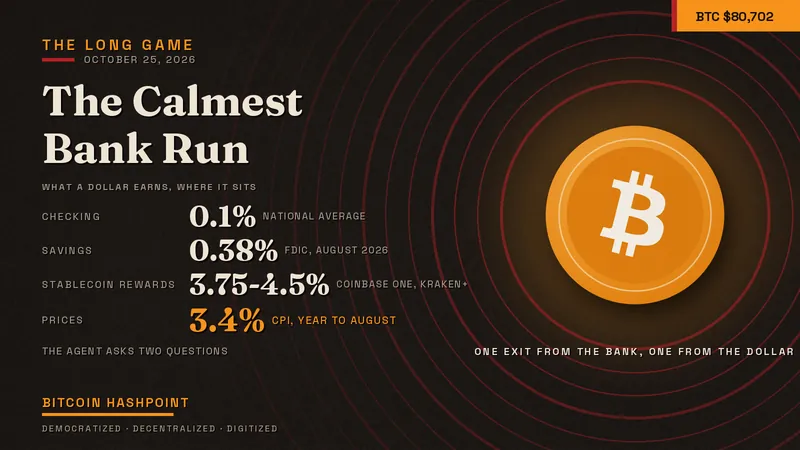
On September 27, Apollo's chief economist Torsten Slok published a note titled "Is an Agentic bank run coming?" His point was blunt. Checking accounts pay a national average of 0.1%. Other accounts pay 3.3% to 5%. If every household used an AI agent to optimize its cash, he wrote, banks could lose a large share of "the cheap deposits they rely on to make loans."
This Long Game follows that money out the door. It goes first into Treasury bills, by way of a new kind of dollar, and the trail ends at a question about what the dollar itself is worth.
The sleepiest money in the world
Banks have always earned a quiet profit from inertia. Moving money takes a login, a form, a phone call and a little attention, and most people never get around to it. The Financial Times counted about $1.6 trillion of deposits at JPMorgan Chase, Bank of America and Wells Fargo that pay no interest at all. At a Treasury bill rate near 3.9%, roughly where the Fed's policy rate sits, that money would earn about $62 billion a year for its owners. Today the banks keep that spread.
The national averages tell the same story. The FDIC put the average savings account at 0.38% in August and the average money market account at 0.63%. Meanwhile consumer prices rose 3.4% over the year to August.

Hashpoint arithmetic makes the cost plain. A dollar in a checking account at 0.1%, with prices rising 3.4% a year, keeps about 72 cents of its buying power after ten years. The same dollar in Treasury bills near 3.9% ends the decade slightly ahead of prices, before taxes. The gap between those two outcomes is the whole bank run, waiting for someone to bother.
Software never gets tired of bothering. PYMNTS Intelligence found that 37% of AI power users already rely on AI as their main tool for managing money, and that among mainstream AI users the share doubled from 14% to 28% in a single month. None of those surveys show agents moving deposits between banks yet. The habit comes first; the permissions come later.
The new buyer of the debt
Follow the money that leaves. Much of it now lands in a stablecoin, a token that promises one dollar and keeps the dollar in reserves, mostly in short-term U.S. government debt.
Stablecoins reached about $300.9 billion on October 1, the RWA Foundation counted, and Tether's USDT held 61% of the supply. Tether alone holds more than $141 billion of Treasury exposure, which puts a crypto company among the twenty largest holders of U.S. government debt in the world, alongside countries.

Washington noticed. Congress passed the GENIUS Act in July 2025, the first federal law for payment stablecoins, and Treasury Secretary Scott Bessent has spoken of the market growing tenfold by the end of the decade, to about $3 trillion by 2030. He has said Treasury watches stablecoins and money market funds closely as "large investors in Treasury bills." The government carries more than $40 trillion of debt and pays more than $1.1 trillion a year in net interest, so a new buyer that must hold bills by law is not a side issue. It is a funding plan.
Call it what it is: a stablecoin scheme for Treasury demand. Every new stablecoin dollar sends a dollar into short-term government debt. Every dollar that leaves a checking account for a stablecoin moves from a bank's loan book into the Treasury's bill book.
The fight over the yield
The law tried to keep the two worlds apart. The GENIUS Act bars stablecoin issuers from paying holders for simply holding the coin. Banks wanted that wall, because a stablecoin that pays 4% looks a lot like a savings account that pays ten times the national average.
The wall has a door. Exchanges and wallets pay "rewards" on stablecoins they did not issue. PayPal pays 4% on PYUSD, Coinbase One pays 3.75% on USDC, and Kraken+ pays up to 4.5% on USDG. On October 21 the Office of the Comptroller of the Currency finalized the first federal rule under the act, effective January 18. It will judge rewards programs case by case and offers no safe harbor to existing ones; the OCC "declines to presume that rewards programs that predated the GENIUS Act comply." It also dropped the stricter presumptions in its proposal. The American Bankers Association's Rob Nichols said the rule will "preserve the status quo for crypto platforms." The broader market structure bill that might have settled the question stalled in the Senate in September.
The White House's own economists ran the numbers in April. The Council of Economic Advisers estimated that banning stablecoin yield entirely would add only about $2.1 billion of bank lending, about 0.02% of all loans, and called the concern "quantitatively small." Its largest scenario reached $531 billion, but only under assumptions the council itself called implausible. On today's evidence the deposit drain runs slow.
Slow is the operative word, and agents change speed. Standard Chartered estimated last year that up to $1 trillion could leave emerging-market banks for stablecoins by 2028, and wrote that stablecoins "are still likely to be adopted even in the absence of yield." People in Egypt or Pakistan do not need a reward to prefer a dollar that their own bank cannot devalue. In America the reward does the persuading. An agent removes the effort.
What the calm run does
Put an agent in front of every checking account and the structure changes in a few predictable directions, without anyone forecasting a date.
Banks pay up or shrink. A bank that loses its free deposits must either pay market rates to keep them or fund its loans some other way. Either path narrows the spread that has paid for branches and small business loans. Community banks feel it first, because they rely most on loyal, low-cost deposits.
The Treasury gets a captive buyer at the short end. Stablecoin reserves sit in bills, not in ten-year notes. A growing stablecoin market pulls the government toward shorter borrowing, which means its interest bill tracks the Fed's rate more closely. The research memo this publication ran on October 13 found the Treasury already leaning on bills and buybacks while the Fed raised rates in September.
Money moves faster in both directions. An agent that moves a deposit at midnight can move it back at 12:01. The same speed that drains a sleepy account can drain a stablecoin issuer or a fund if trust cracks. Silicon Valley Bank showed what phones did to a run. Agents finish the thought.
The second question
So far every dollar in this story stays a dollar. The calm run moves money from a bank to a bill, from one corner of the dollar system to another. It rescues savers from 0.1%, and it rescues the Treasury from a shortage of buyers. In that sense the stablecoin is the dollar's best salesman.
But an agent told to maximize yield will eventually meet a harder instruction: keep my purchasing power for thirty years. That instruction asks a different question. It asks what the yield is paid in.
A Treasury bill near 3.9% against prices rising 3.4% leaves a real return of about half a percent, before taxes. The government that pays the bill is also the one that sets the supply of the dollars it pays in, and it runs a deficit large enough that the interest alone exceeds the military budget. An honest agent has to price that.
Bitcoin answers the second question and ignores the first. It pays no yield. An agent optimizing for this month's rate will never buy it, and the calm run, in its first phase, flows almost entirely into dollars. The bitcoin case lives on the longer horizon: a supply schedule that no bank or Treasury can change, ending at 20,999,999.9769 coins. At Thursday's close of $81,307, about 20.1 million of them carried a value of about $1.6 trillion, roughly five times the entire stablecoin market.

Two exits, then, and they are not the same door. A stablecoin is the exit from the bank. Bitcoin is the exit from the denomination. The first one opens now, because software makes it effortless. The second opens one agent at a time, as the software starts to ask what its owner will need in 2056, not next Tuesday.
What to watch
These signals show which way the story moves, and none of them needs a date.
- Agents that move money. The first mainstream assistant that sweeps a user's idle checking balance into a higher-yield account by default marks the start of the calm run.
- The rewards rulings. How the OCC treats exchange rewards programs after January 18 decides how much of the yield gap stablecoins can close inside America.
- The stablecoin share of bills. Watch Tether's and Circle's reserve reports against the size of the bill market. A captive buyer at the short end changes how the Treasury borrows.
- Deposit costs at community banks. The FDIC's quarterly data on what banks pay for deposits will show the run before any headline does.
- The real yield. The gap between the bill rate and inflation is the number a long-horizon agent will care about most. When it turns negative, the second question gets louder.
The Hashpoint read
The AI bank run is not a crash. It is an efficiency. It pulls money out of accounts that pay nothing and into instruments that pay the market rate, and most of those instruments are still dollars, still backed by government debt. Banks lose a franchise built on human inertia. The Treasury gains a buyer that the law requires to hold its bills. Savers stop leaving $62 billion a year on the table at three banks alone.
The structure underneath is the part that matters for the long game. Once money moves at machine speed and machine diligence, every holder gets the same patient analyst, and that analyst reads the fine print on every unit of account. The first question it asks is where the best rate is. The second is what the rate is paid in. Bitcoin has no answer to the first and the only fixed answer to the second, and the calmest bank run in history is the moment the second question gets asked at scale.
Data: Torsten Slok, Apollo, "Is an Agentic bank run coming?", September 27, 2026, via CoinDesk (September 28, 2026) and PYMNTS (October 8, 2026; 0.1% checking average, 3.3% to 5% alternatives; Financial Times count of about $1.6 trillion of non-interest deposits at three banks; PYMNTS Intelligence survey figures); Federal Reserve review of Silicon Valley Bank, April 2023 (more than $40 billion of outflows on March 9, 2023); FDIC national rates for August 2026 via SavingAdvice (savings 0.38%, money market 0.63%); Bitcoin Hashpoint research memo, October 13, 2026 (CPI 3.4% for August 2026; federal funds target 3.75% to 4.00% and IORB 3.90% from September 17, 2026; total public debt about $40.3 trillion; FY2026 net interest $1.143 trillion against $916 billion of military outlays, CBO); RWA Foundation via Coin-Turk (stablecoins $300.9 billion on October 1, 2026; USDT 61%); Spark research, June 22, 2026 (Tether Treasury exposure over $141 billion, among the twenty largest holders); DL News, November 13, 2025 (Bessent, $3 trillion by 2030, "large investors in Treasury bills"); CoinDesk, October 21, 2026 (OCC final rule, effective January 18; rewards rates at PayPal, Coinbase One and Kraken+); Roll Call, October 22, 2026 (Rob Nichols, ABA); Council of Economic Advisers, "Effects of Stablecoin Yield Prohibition on Bank Lending," April 2026; The Block, October 6, 2025 (Standard Chartered, Geoffrey Kendrick and Madhur Jha); Bitcoin Hashpoint dashboard (Bitcoin $81,307.16 at the October 22, 2026 close; supply counted by node Hal). The $62 billion, the 72-cent decade, the real yield and the market-value comparison are Hashpoint arithmetic. Structural reads, not forecasts. Nothing here is investment advice.
Get the Hashpoint by email twice a week, Wednesday and Saturday: subscribe free, one click to unsubscribe.